Verse

Gurus say…

Gurus say “Live life in the moment.” The past and future are mere figments of our imagination. To live in those realms is to live life in a dream. To sleepwalk.

I think a lot of people live for the future, however, because they realize their present situation is not good. And they want to make it better. They know, or at least have an unwavering faith, that when they accomplish that goal, when they solve that problem, when they meet that person that completely and utterly shifts their life into almost an elevated consciousness, they know then that things will be better. And the present is tolerable, but that’s not why they live. They live for that ideal, that faith in something bigger, greater, more real or more beautiful.

Our mortal bodies will all eventually succumb to entropy and decay. They will return to the dust from whence they came. But the notion, the idea lives on. Ever searching, ever hoping, ever believing that there is a place greater than this. An infinite love that finally feels like home.

Standard
Verse

Be the monkey wrench

Reinvent yourself.
The public,
they won’t know what to make of the new you.

They will try and try to mold you
into the preexisting notion of your former self.

For that is the comfortable idea
that fits snugly as a cog,
in their unconscious belief system.

Explode from these rigid machines.
They do not define you.

When their engines break down,
be the monkey wrench
that initially seized the process
and now fixes their thinking.

Standard
Profiles, Verse

Ever have deja vu?

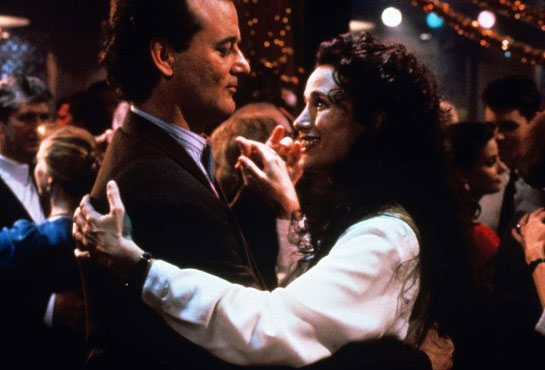
Billy Murray and Andie MacDowell

Didn’t you just say that?

It’s amazing what you can do with the Internet nowadays. Many networks are engaging in convergent entertainment, which simulcast their varying modalities of mass communication online and on television. One such species of this information evolution has mutated into the form of pop-up video—what the long-running series LOST referred to has “enhanced” viewing and originally made relevant by the pop-culture, music-video phenomenon, aptly named VH1’s “Pop Up Video.” In the case of American Movie Classics (AMC), the spontaneous updates occasionally invite viewers of this network’s regular programming to visit AMCTV.com, for background on their current viewing interest.

I was watching Groundog Day on AMCHD recently, during one such dynamic broadcast.

The epiphanous caption read ‘Bill Murray spoke to his wife in her sleep on their wedding night.’ It popped up while Murray spoke to Andie MacDowell on the screen, as she sleep acted. That’s kind of an intimate fact about Murray’s life though, isn’t it? Where’d they verify that? Who were their fact checkers? I noticed they didn’t get a direct quote from the smooth-talking Ghostbuster himself.

They did, however, quote him in saying that Groundhog Day was a turning point in his career. It was the movie, premiering Feb. 2, 1993, about which the New York Times reported “Mr. Murray is back in top form with a clever, varied role that draws upon the full range of his talents.”

That’s why, when people ask, “What About Bob?” I always say, ‘Don’t forget Groundhog Day.’

Just before the credits scrolled up AMC’s ultra-crisp, high-definition display, one of the last popups quoted the Co-writer and Director of Groundhog Day Harold Ramis in saying that the movie received a positive response from people of all creeds, religions and philosophies.

Standard
Verse

“No thank you. I don’t Facebook. I’m on the patch.”

Here’s the problem with Facebook: it’s an opiate of the people. It’s working its tendrils into every sector of the Web and, when it inevitably collapses, all of those sites whose sustenance were entirely dependent on the lifeblood delivered to them from the decaying Facebook circulatory system, will die. And Facebook is setting up shop at every Mom & Pop site through a harmless sounding enough (in actuality) Trojan Horse. They call it “Open Graph.” Without getting into too much techno babble (of which I know little), let me just illustrate this supposed beneficial societal concept…

Facebook vs. Twitter

People sometimes ask me What’s the difference between Twitter and Facebook? I often lose them about 30 seconds into my failed attempt at describing the similarities between Facebook’s News Feed and Twitter’s entire platform. Guess which one came first. Anyway, I’m developing a webpage for a local charity (Deb & Jackie’s Jolly Jump). The page contains multiple profiles of some of the JJ’s jumpers. If people like what they see/read, I want them to be able to share it. When I went to the Twitter Developer website, I simply generated, copied and pasted the necessary code within five minutes. I then strew the two or so customizable lines throughout my page’s code. Now people can personally tweet out their favorite jumpers. Period.

When I wanted to allow similar functionality for exclusively Facebook users, they first wanted me to develop a Facebook app. Then, they wanted me to insert “Open Graph” code into the core of the webpage. This code, mind you, has changed several times since its initial inception. Code that’s likely to change again. So even if I had figured this “Open Graph” out, I’m sure I would have had to change it within six months. Nothing like tampering with fairly sensitive areas of your website on a regular basis. Not to mention, Facebook can siphon information from your Open Graphed site to feed its insatiable desire for information. About an hour into researching the dregs of specific Facebook code, I decided to throw in the towel and write this blog post instead.

If someone ever asks you What’s wrong with Facebook?, just point them to this story. And tell them it took me five minutes to do in Twitter what it took me over an hour to realize wouldn’t even be worth doing on Facebook.

If you agree, just click the share button below and send to…  [sigh]  Facebook.

Standard
short stories, Verse

The Whole of Milk

whole milk

I buy whole milk for three reasons.

#1. It tastes good.
#2. I don’t drink milk a lot (so I don’t really have to worry about the additional fat), which leads me to…
#3. It takes the longest to go bad.

If you’re an avid milk drinker, then skim may be the way to go. 1% and 2% seem like something invented by the dairy farmers trying to output more product. You can put cream in your coffee.

mikedelrosso.com

Standard
off the book, Verse

EPILOGUE

Some time later…

I am in a room, a one-bedroom studio. I am sitting in front of a large Zenith floor-unit tube television. This thing must be from the mid-20th Century. All of a sudden, and with a faint click and hum, the large screen lights up. Just in time for the 6 o’clock news.

“In local news tonight: the tiny Town of Westchestertonville has miraculously sprung up on the grid out of seemingly nothingness. For months now the town had gone dark, cut off from the vast majority of society. Federal authorities are still scrambling to muster an explanation of how they could have missed such a large oversight for this long. It also leaves some people wondering how many of these towns are still out there, excommunicated from the almighty Internet.

“In world news, the apparent seven-year itch as it were, that has plagued so many relationships due to a faulty Bookface matchup, seems to be receding a bit, as more and more daters revert to meeting people in person. We tried calling Bookface CEO and Founder Darryl Schmuckersburg for a possible explanation at this sudden departure from his long established norm, but he was unavailable for comment. In recent years, Schmuckersburg had come under fire for his supposed failed algorithm, but had somehow always kept the public at bay with reassurances that he was simply working out the bugs. I guess the people were finally fed up.” The newscaster’s look grows dark and seems to penetrate through the red-blue-green pixels of the tube and looks into my soul. Now, it’s as if he’s talking to me.

“Attention Mr. Schmuckersburg, if you’re viewing this and hearing my voice, then your mind has not doubt grown tired of the infinite loop, which has kept you in its clutches for…” he looks down at a digital display on his handheld tablet, “now a little more than two months. In this time, the Town of Westchestertonville, which you shrouded in darkness and cut off from the rest of the world for the benefit of your Bookface® social monopoly, has been freed. The author of your digital prison thought it fitting to give you this message when you awoke, to both ease you out of the coma and let you know of your wrongdoing. You tried to rob this quaint little society of its humanity for your own vain agenda. Conversations, Mr. Schmuckersburg, relationships, the foundations on which our collective human genome operate cannot be reduced to information commodities for you and others like you to deal as capital. We are people, Mr. Schmuckersburg. And we’ve taken our lives back. I hope that in this account you have been able to step into the shoes of some of these men and women, albeit an infinitessimally small fraction of one percent of those you’ve harmed; that you’ve seen the world through their eyes, and experience reality as they have; and maybe, just maybe, you can relate.”

“Can’t you see?!” I say. “I know what is right! Just give me some more time and I can work out the kinks. Humanity will be better with Bookface®. Believe me!” But the news anchor just looks down at the papers he’s shuffling on top of the desk and sighs.

“Very well,” he says, the well seems a whole octave lower in tone. Then a robotic voiceover plays as the newscast fades out.

… End transmission. Initiate infinite eight sequence 6281982. Congratulations, Mr. Schmuckersburg, you are being infiniteighted.


OFF THE BOOK

Standard
short stories, Verse

Occupy Peace of Mind

The tweet that changed my life

The 140 characters that launched my career.

Say what you will about the Occupy Wallstreeters. The fact remains, they were there, on Zuccotti Park, occupying Wall Street, in New York City for a time. They may not have been focused in their demands or hygienic under their armpits, but they made their presence known (in all its olfactory splendor). It’s easy to look down one’s nose at this ragged rabble, when one has a job or at least somehow secured a flow of income. Yet when one is desperate, despondent, unable to support the very basic needs all people deserve as inalienable rights–food, shelter, a purpose, frankly–it’s hard to dismiss these financial district freeloaders. And it reminds me of the time not too long ago, when I was unemployed. If I didn’t have a job right now as I type this message, I can’t help but think I would have hitched my tent to this stationary movement. But the fact of the matter is that I do have a job. This is the story of how I got there.

It was May of 2009, I had just received a master’s in print and multimedia journalism from Emerson College in Boston. I was reluctant to embark on the job search (one of the last stories I had written for my classes addressed a 7.4-percent national unemployment rate, which, if anything, has gotten worse since then). So I went on a road trip for three weeks, out to L.A., to clear my head and perhaps formulate a plan of attack. Upon return, I hadn’t given a job much thought, but I was equipped with a master’s degree and some previous (albeit irrelevant) office work experience. Enough right? Here I cannot stress the importance of who you know. For, as it turned out, the vast majority of employers did not care or understand what I knew, evidenced by the sheer lack of response or acknowledgment of my existence as I scattered hundreds of resumes into the ether of the Internet, with no hope of reciprocation. They say many people go to Harvard University, not for the education, but for the connections. Well, Emerson seemed to work this way too as I found myself calling the one contact I had at the Boston Herald via a connection forged within the Emerson master’s program.

So, at 27, with a bachelor’s degree, a master’s degree and three years of work experience under my belt, I was able to secure 15 hours a week covering high school sports for a Boston newspaper. No one could deny the prominence of the Boston Herald, but 15 hours per week at a meager stipend of $13/hr would not pay the bills. I had to move home. With some residual loans from undergrad and a brand new heap of grad loans, I was close to $80,000 in the hole and making the salary of a part-time pizza delivery boy. In 2009, upon the height of my education, I had hit financial rock bottom.

I remember my day-to-day during this sobering point of reflection. I’d roll out of bed around 11 a.m. and make a small breakfast of toast or something else light to save room for lunch, which was right around the corner. I’d deliberately NOT turn on the TV. That was a procrastinator’s worst enemy, an attention deficit factory, that I could not endure while trying to keep focus on the almighty full-time gig, the bandaged pressure on a hemorrhaging bank account, the ticket out of my childhood bed and into adulthood. Instead, I’d force myself to get ready, though I had nowhere to go. I’d shower and shave and brush my teeth. I’d get dressed and sling my messenger bag over my shoulder that held a $300 netbook I had bought with my last cent. And I’d walk, in the middle of the day, to the town center, where a turkey club and hot chicken noodle soup from Barry’s Deli would warm me up. I’d continue to the Coffee Break Cafe up the street and assemble my makeshift workstation within the little shop to scour job listings, as the aroma of a steaming cup of coffee percolated my will to fill online applications.

Days like this went on for about a year. In that time, I had many tests of faith. Faith in myself. Faith in society. I’ll admit: a life of crime had even crossed my mind on more than one occasion. The overwhelming uncertainty of employment had me certain I would never find work. And so, I know where the #OWS movement is coming from. I have been where these people are now. Abandoned. At a loss. Forgotten. Failing. For these reasons, I see their plight. Yet I can no longer commiserate with the 99 Percent. I have a job. It happened like this…

A series of events leads to more experience that builds upon my existing skill set

Pulling together any scrap of expertise I could get my hands on, I chronicled the breadth of my experience, thus far, on an online portfolio (luckily, I knew a web designer, also fresh out of school and who output a good product for cheap for the experience). I filled it with published Boston Herald clips and stories from Emerson classwork and internships. And within several months, a curriculum vitae (CV) in such a viable and succinct format had catapulted me to the assistant webmaster position for a prominent website.

After two years of virtually no leads, it happened that quickly. I’ll never forget that day…

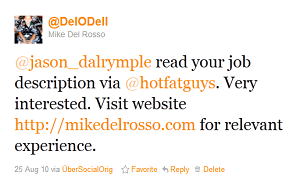
It was a typical humid and hazy Boston day, in late August 2010. Someone I followed on Twitter tweeted the opening to a fairly popular website. The job description detailed a skill set that matched my expertise. So, without hesitating, I replied to those fateful 140 characters, including the short link to my e-portfolio. I was emailing my would-be boss within hours and secured an interview that very same day. Inside of a week, I secured that gig, which still did not pay a lot, but it provided the almighty experience and expanded knowledge of my craft.

As my mind and CV continued to grow within the hallowed walls of that Web institution, I had more to offer, thus more options to entertain. And finally, at the then apex of my career, I landed a full-time job. The hiring manager said she liked how I had garnered such a diversity of experience. That may have been what won me the job, in fact.

Now I wouldn’t have gained that prominent experience, had I not designed the e-portfolio. And my e-portfolio would have been bunk, had I not acquired clips from the Boston Herald, along with several other internships. I couldn’t have reported for the Boston Herald or for those internships without my Emerson networking and education. I guess what I’m trying to say: Thank God I checked my Twitter feed on that humid August day.

Related links:

Standard
awkward, Verse

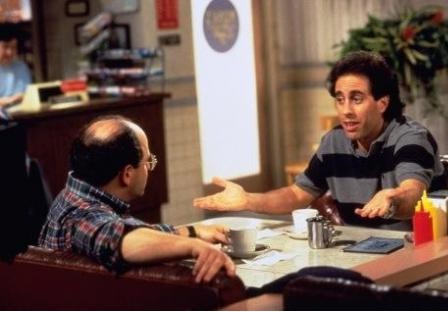
I’M NOT DRIVIN’ HIM to the AIRPORT!!: Seinfeld conversations…

Jerry and George sitting in a booth talking at Monk's Restaurant

She was like 6-foot-5.

GEORGE
It’s my life dream to have sex with… just a giant woman.
JERRY
So you’ve set different goals for yourself than Edison, Magellan, these sorts of people?
GEORGE
Magellan?!
JERRY
Magellan, the famous explorer.
GEORGE
Magellan??
JERRY
C’maahhn. Around the World! Who do you like?
GEORGE
I like de Soto.
JERRY
de Soto? What did he do?
GEORGE
de Soto, the conquistador. He discovered the Mississippi.
JERRY
Oh. Ya. Like they weren’t gonna find that anyway.
GEORGE
Don’t you have to drive Keith Hernandez to the airport?
Standard
awkward, Verse

Fun Fact #1

"Is this where the real Caesar stayed?"

“I can’t get a sig’ on my beeper.”

I tried typing that into my phone once and uncovered a hidden feature on the BlackBerry. If you type the first three letters of the word ‘signature,’ then SPACE, the smart phone will automatically insert a preset electronic signature into the field, like something you’d see at the end of an official email.

Hit the ‘Menu’ button. Then select ‘Settings’ (the little, orange wrench icon). Scroll over to ‘Options’. Find ‘Owner’ in the alphabetical list. Now enter the text you wish to sign off with.


When I hit ‘sig,’ this appears:

"Is there a payphone bank?"

Mike Del Rosso
Asst. to the Traveling Sec’y
movierain® productions
4 Garden Ct. #5
Cambridge, MA 02138

del@mikedelrosso.com

This text also appears on the home screen when you lock the phone. It’s like luggage tags for your high-tech baggage.

Mike Del Rosso
Asst. to the Traveling Sec’y
movierain® productions
4 Garden Ct. #5
Cambridge, MA 02138

del@mikedelrosso.com

Standard